


What You’ll Find on This Page
Good lighting changes camp more than most people expect. A campsite with the right camping lights in the right spot feels easier to use, easier to move through, and a lot less frustrating once the sun drops. Cooking goes more smoothly. Steps, guy lines, and storage areas are easier to judge. Inside an RV, the space feels more livable than gloomy or harsh.
This page consolidates the book’s lighting guidance into a single practical place. You’ll find the main lighting categories covered in the book, quick selection notes for each one, and buying guidance that helps narrow the field without getting lost in gadget talk. The focus here is not on collecting more camping lights. It is on matching each light to the job it actually needs to do.
The categories here cover the most useful lighting roles around camp and in an RV: lanterns for shared spaces, headlamps for hands-free movement, flashlights for directed beam work, string lights for softer support, solar lights for low-demand use, and interior and exterior RV lighting for daily functions and nighttime safety. You will also find a short decision guide, a buying checklist, accessory ideas, and a FAQ section that answers the kinds of questions campers usually ask after dark, usually while holding the wrong light for the job.
Use this page as a fast-reference companion to the book. Read the book for the fuller reasoning, trade-offs, and setup logic. Come back here when you want a clean refresher on which lighting type fits a table, a path, an awning, a galley, or an RV entry step. That is usually where the real decision gets made.
SETUP TIP
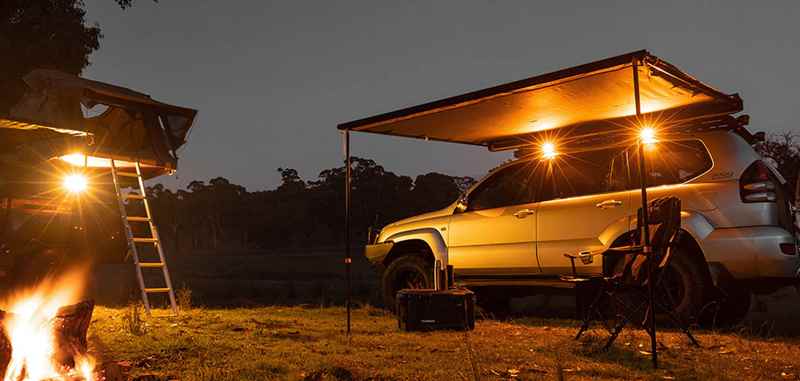
Hang or place your main area light slightly above eye level and close to the real work zone. You get better coverage, less glare on the table, and fewer deep shadows than you do from a light sitting low and blasting outward.
Quick Gear Summary
- Lanterns for shared campsite lighting
- Headlamps for hands-free chores and short walks
- Flashlights for controlled, directed light
- String lights for soft ambient support
- Solar lights for paths and low-demand marking
- RV interior lighting for living, reading, cooking, and storage access
- RV exterior lighting for steps, entries, awnings, and road visibility
Product Recommendations by Category
The products below represent commonly recommended options within the camping lights categories discussed in this book.
This guide organizes lighting by role more than by brand. Use the category notes below to build a short list of current options that fit how you camp, how much light you really need, and how much power you want to spend on it.
Lanterns for Area Lighting
Lanterns make the most sense for the middle of camp: the picnic table, the cooking area, or the seating zone under an awning. Look for broad, even output, a truly usable low mode, steady hanging or placement options, and a runtime that gets through a full evening without drama.
Headlamps for Hands-Free Use
Headlamps are ideal for campers who are constantly moving, setting up, washing dishes, handling gear, or walking the dog after dark. The best ones are easy to operate without thinking, have more than one practical brightness level, and do not punish you with glare every time you turn your head.
Flashlights for Directed Light
Flashlights work best as quick-grab camping lights for checking the site edge, scanning under a trailer, or walking short distances with a focused beam. Favor simple controls, a beam pattern that fits real camp use, and a size that is easy to keep near the bed, door, or gear tote.
String Lights for Ambiance and Low-Level Support
String lights are best used as background support, not as the star of the lighting plan. They work well under awnings, along canopy frames, or around a sheltered sitting area where a softer glow helps define space without turning the site into a parking lot.
Solar Lights for Pathways and Light-Duty Use
Solar lights are ideal for low-demand tasks such as marking a path, outlining the campsite edge, or making tent lines easier to spot. They are most useful on longer stays where the site layout stays put and where a missed charge is annoying, not a real problem.
RV Interior Lights for Daily Living
RV interior lighting matters in kitchens, dinettes, bunks, bathrooms, closets, and stepwells, where poor fixture placement gets annoying fast. Look for balanced brightness, useful task coverage, a sensible color temperature, and fixture choices that make a small space feel workable rather than harsh.
RV Exterior Lights for Safety and Access
Exterior RV lighting earns its keep around steps, doors, awnings, storage access, and nighttime arrivals. Prioritize fixtures that improve footing, visibility, and routine movement first, then consider broader campsite comfort and any road-use lighting upgrades that need to remain compliant.
Disclosure: As an Amazon Associate, we may earn from qualifying purchases.
Gear Comparison Guidance
Compare camp lighting by job before you compare it by specs. A lantern may lose on beam distance and still be the better pick for dinner prep because it lights the whole table instead of one plate. A headlamp may feel less impressive on paper than a flashlight, yet it often wins the moment both hands are busy.
Pay attention to how a light behaves at the level you will actually use. Runtime at a dim emergency setting is not the same thing as runtime during real evening camp use. A slightly less powerful light with better output control can be the smarter choice.
There is also a comfort angle. Warm light usually feels better in shared living areas. Cooler light can help with detail work. Small, packable camping lights are easier to carry, but larger ones sometimes earn their bulk by anchoring the whole campsite. Fast setup matters when you move often. Stability matters more when the light stays out every night.
The trick is simple: do not ask one light to do five jobs badly. Build a small lineup where each light has a clear role.
Quick Decision Guide
- If you cook and eat outside most nights, start with a lantern that gives broad light over the main living area.
- If you move around camp often after dark, a headlamp usually saves more hassle than another handheld light.
- If you want a soft, evening feel under the awning, add string lights after your main lighting is complete.
- If your site stays put for several days, solar markers can make paths and edges easier to read with almost no effort.
- If your RV feels dim in the wrong places, improve task lighting at the counters, dinette, bed, or stepwell before swapping every fixture.
- If you dry camp or boondock often, lean hard toward efficient LED options with realistic runtime and low power draw.
Buying Considerations
- Broad area coverage versus narrow beam focus
- Useful low mode, not just a flashy high mode
- Runtime at real working brightness
- Rechargeable, disposable battery, or solar power source
- Weather resistance and general durability
- Ease of charging before and during a trip
- Size and storage fit in your camp setup or RV
- Glare control around tables, awnings, and small interiors
- Warm versus cool color tone for the space
- Simple controls that still make sense in the dark
Accessory Ideas
- Spare rechargeable battery bank or power station charging cable for keeping primary camping lights ready
- Light hooks, clips, or hanging loops for better lantern placement over tables and prep areas
- Motion-activated step or closet lights for RV entry points and storage weak spots
- Diffusers or softer lens options for reducing harsh glare in tight spaces
- Small gear pouch or organizer for storing string lights, charging cables, and backup batteries
- Lens-cleaning cloth for lanterns, solar panels, and RV exterior fixtures that lose output from grime
Camp Lighting FAQs
How bright should camping lights and lighting be?
Bright enough to handle the job without washing out the whole campsite. A table, prep area, or RV step needs usable light, but too much output creates glare and makes the site feel harsher than it needs to. Moderate, controlled lighting usually works better than one oversized light on full blast.
Is a headlamp better than a flashlight for camping?
For many routine camp tasks, yes. A headlamp keeps both hands free, which makes it better for setup, dishwashing, gear sorting, leash handling, and late-night walks around camp. A flashlight still has value for quick-grab use and longer, more directed beam work, so the two often complement each other well.
Are string lights enough for a campsite?
Usually not on their own. String lights help define space and provide low-level ambient light, but they rarely provide the usable light needed for cooking, reading, or detailed camp chores. They work best as support lighting after a lantern, task light, or headlamp already handles the main jobs.
Do solar camping lights work well?
They can work very well for low-demand jobs such as path marking, edge definition, and basic orientation around camp. They are less dependable for anything critical because performance changes with sun exposure, weather, shade, and product quality. Treat them as support lights, not your main work lights.
What is the best lighting setup for an RV interior?
A layered setup usually works best. Use ambient lighting for general visibility, task lighting where real work happens, and lower-output support lighting for closets, bunks, stepwells, and nighttime movement. That mix makes the RV feel more comfortable and more useful than relying solely on ceiling lights.
Why are LEDs usually the smart upgrade?
LEDs solve several practical problems at once. They draw less power, run cooler, last longer, and hold up better in mobile camp and RV conditions. That matters whether you are stretching battery life off-grid, improving RV fixtures, or simply trying to avoid camping lights that burn hot and need frequent replacement.
Other Resources
If you want a few solid follow-up reads on campsite lighting, RV fixture upgrades, and the most common lighting gear types, these are good places to continue.
- Brighten Up Your Campsite: Step-by-Step Guide to Achieving and Setting Up Ideal Lighting
- A Guide to Choosing the Best Camping Flashlight
- Camping Lanterns for Tents – 8 Best Options
- Enhance Your RV Experience with LED RV Lighting Fixtures
- Illuminate Your RV: A Step-by-Step Guide to Upgrading Interior Lighting
Keep Exploring Related Gear Topics
Lighting works better when the rest of the camp works with it. These related gear pages pair well with lighting decisions and help round out a more comfortable setup.
- Camp Chairs That Don’t Wreck Your Back
- Camp Tables, Prep Surfaces, and Folding Furniture
- Camp Sleeping Gear
- Outdoor Living Spaces
- Storage and Organization Helpers
Closing Guidance
Good camp lighting is less about buying a pile of gadgets and more about solving the little problems that show up every evening. A better lantern over the table can make dinner feel easy again. A headlamp with sensible controls can save a dozen small annoyances in one trip. A low step light on an RV can prevent that awkward half-miss in the dark that nobody enjoys. Building a system with the right camping lights that work together will make a world of difference.
That is why the best lighting decisions usually start with friction. What keeps going wrong after sunset? Is the table too dim? Is the path hard to judge? Are the RV steps poorly lit? Is the galley bright overhead but still shadowed right where the work happens? Start there.
From that point, the trade-offs become clearer. Some campers need lighter, smaller gear because they move often. Others can justify a larger lantern because it anchors the same site for several nights. Some RV owners need softer interior light for comfort. Others need stronger task lighting in just two or three weak spots. There is no prize for the brightest setup. The win is a campsite or RV that works well and still feels good to be in.
Use the book when you want the deeper reasoning behind the role of all lighting, setup choices, and upgrade paths. Use this page when you want a quicker reminder. The smartest lighting setup is usually the one that feels almost invisible because everything is simply easier to do.
Last updated: 04/26


